The Twelve Wild Geese
The queen’s wish

Long ago there was a king and a queen who had twelve sons, and not one daughter.
One winter’s day, when the yard was white with snow, the queen looked out of the window and saw a raven standing in the snow beside a sprig of red holly berries.
“Oh,” said she, “if only I had a daughter with skin as white as that snow, and cheeks as red as those berries, and hair as black as that raven, I would give away all my twelve sons for her!”
The moment she said it, a shiver went through her, and there in front of her stood a stern old woman.
“That was a wicked wish,” said the old woman, “and it will be granted. You will have such a daughter. But on the very day she is born, you will lose your sons.” And with that she was gone.
Twelve wild geese

And that is just how it happened. On the day the baby girl was born, there was a great whirling and whistling in the palace.
Out through the open window flew twelve wild geese, one after another, away over the woods. The twelve princes were gone.
The king was full of sorrow for his sons, and he never knew that it was the queen’s wish that had sent them away.
They called the little princess Snow-white-and-Rose-red, and she was the most loving and lovable child that ever was.
The secret

When she was twelve years old, she began to be sad and lonely, and she asked her mother again and again about her brothers. At last the queen told her the whole story.
“Then it was because of me that my brothers were changed into wild geese,” said the princess. “Before the world is a day older, I will go and find them, and try to set them free.”
That very night she slipped away into the woods, and she walked all night and all the next day. She had a few cakes with her, and on the way she ate nuts and rose-hips and wild crab-apples.
The house in the wood

At sunset she came to a little wooden house in the wood. She went in, and there she saw a table laid with twelve plates, and a good fire, and in the next room twelve beds.
Then she heard the gate open and footsteps on the path, and in came twelve young men. When they saw her, their faces were full of surprise and sorrow.
“Oh, what has brought you here?” said the eldest. “Because of a girl we had to leave our father’s house, and for twelve years we have been wild geese all the day long.”
“But I am your own sister,” said she, “and I never knew a thing about it until yesterday. I have come to find you, and to set you free if I can.”
The brothers looked at the floor, and you could have heard a pin drop. For how could anyone set them free?
Twelve shirts

“I’ll tell you how,” said an old woman, who was suddenly standing among them.
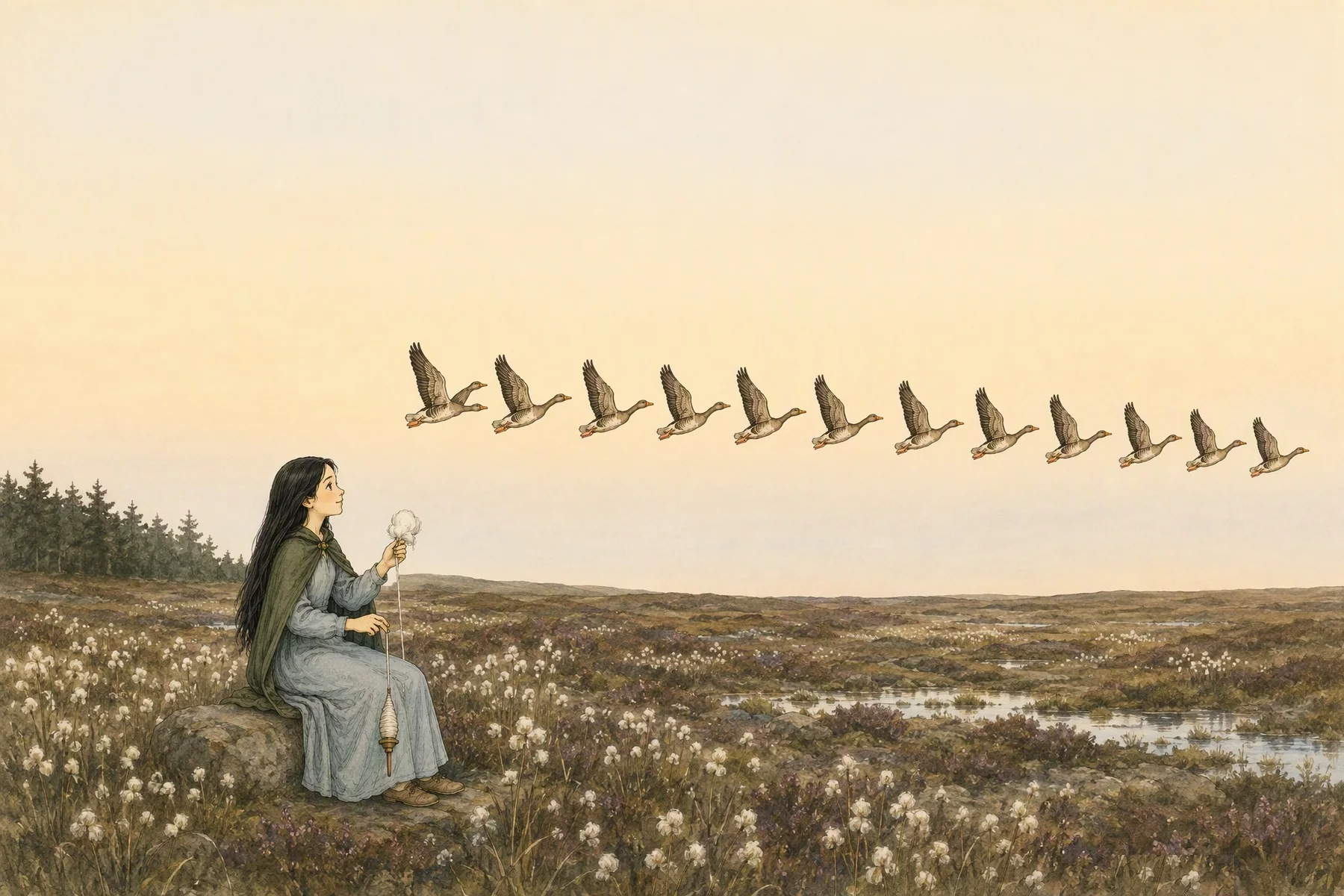
“Your sister must spin and knit twelve shirts for you, out of the soft white bog-cotton that she gathers with her own hands on the moor outside the wood.”
“It will take her five years. And if once in all that time she speaks, or laughs, or cries, you will stay wild geese for ever.”
Then the old woman was gone, and every one of the brothers hugged and kissed his sister.
The young king

So for three long years the princess gathered bog-cotton, and spun it, and knitted it into shirts, and at the end of the three years she had eight shirts made.
In all that time she never spoke a word, nor laughed, nor cried; and not crying was the hardest of all.
One fine day, as she sat spinning at the door, a greyhound bounded up and put his paws on her shoulders and licked her face.
Then a handsome young man came to the gate, took off his hat, and asked if he might come in.
He was the king of the country beyond the forest. He loved her from the first moment he saw her, and he asked her to come home with him and be his wife.
She shook her head many times, for she was sorry to leave her brothers. But at last she nodded, and put her hand in his.
She took her bog-cotton and her eight shirts with her, and they were married, and she answered the bishop with nods.
The wicked stepmother

But the young king had a stepmother, and she hated the new young queen.
When the young queen had a baby boy, the stepmother gave her a sleeping drink, and while she slept, the stepmother stole the baby away.
Then she told everyone that the young queen had given her own baby to the fairies of the wood. And the poor young queen could not say one word to tell them it was not true.
Still she never spoke nor cried, and still she worked on at the shirts. And often the twelve wild geese would come and sit in the trees outside, and look in at her.
The last shirt

Another year went by, and the twelfth shirt was finished all but one sleeve, when a baby girl was born.
And the wicked stepmother did the very same thing again. This time everyone believed her.
The lords and the judges said that the young queen must be sent out of the kingdom for ever, at three o’clock that very day.
The young king was the saddest man in all his kingdom. He went away to the farthest room of his castle, and he would see no one.
The last stitch

At three o’clock they led the young queen out. She carried the pile of shirts in her arms, and as she went she was still sewing the last sleeve.
She put in the very last stitch, and a tear fell from her eye onto the shirt. Then she cried out, “I have done no wrong! Call my husband!”
At that very moment there was a great rushing of wings, and down came the twelve wild geese, and stood all round her.
Quicker than you could count to twelve, she threw a shirt over every goose. And there in the twinkling of an eye stood twelve of the finest young men you ever saw.
Together again

The young king came running. And just then a tall, fine woman came through the crowd, with the baby girl in her arms and the little prince holding her hand.
It was the good fairy. It was she who had taken the two children from the wicked stepmother, and kept them safe all the while.
Then there was crying for joy, and laughing for joy, and hugging and kissing, and the young queen could talk and laugh and cry as much as she liked.
As for the wicked stepmother, she was sent away, and she was never seen again. And there never was such happiness in any palace that ever was built.
For grown-ups
Where it comes from
Patrick Kennedy told this story in The Fireside Stories of Ireland. W. B. Yeats printed it again in 1888, in Fairy and Folk Tales of the Irish Peasantry, and that is the telling we worked from.
What we changed
- In the old telling the queen sees the blood of a calf on the snow. Here it is a sprig of holly berries.
- In the old telling the brothers have sworn to kill the first girl who comes to their house, and the old woman makes them break their oath. Here there is no oath.
- In the old telling a wolf, who is really the good fairy, carries each baby away, and the stepmother smears blood on the sleeping queen’s mouth so that everyone thinks she has eaten them. Here the stepmother steals the babies and says the queen gave them to the fairies.
- In the old telling the young queen is tied to a stake to be burned, and the eldest brother strikes the executioner dead. Here she is to be sent out of the kingdom for ever, and nobody is hurt.
- In the old telling the stepmother deserved to be torn apart by wild horses. Here she is sent away, and never seen again.
Age
Seven and up.
Words
- Bog-cotton, ceannbhán, grows on the bogs and moors of Ireland: a soft white tuft on a thin stem, like a little ball of cotton wool.
- Rose-hips, mucóga, are the fruit of the wild rose. Kennedy calls them mugoreens.
- Wild geese are the grey geese that come to Ireland in winter.
- Snow-white-and-Rose-red is the princess’s name in Kennedy’s telling.
The tale as W. B. Yeats printed it in 1888, after Patrick Kennedy
There was once a King and Queen that lived very happily together, and they had twelve sons and not a single daughter. We are always wishing for what we haven't, and don't care for what we have, and so it was with the Queen. One day in winter, when the bawn was covered with snow, she was looking out of the parlour window, and saw there a calf that was just killed by the butcher, and a raven standing near it. "Oh," says she, "if I had only a daughter with her skin as white as that snow, her cheeks as red as that blood, and her hair as black as that raven, I'd give away every one of my twelve sons for her." The moment she said the word, she got a great fright, and a shiver went through her, and in an instant after, a severe-looking old woman stood before her. "That was a wicked wish you made," said she, "and to punish you it will be granted. You will have such a daughter as you desire, but the very day of her birth you will lose your other children." She vanished the moment she said the words.
And that very way it turned out. When she expected her delivery, she had her children all in a large room of the palace, with guards all round it, but the very hour her daughter came into the world, the guards inside and outside heard a great whirling and whistling, and the twelve princes were seen flying one after another out through the open window, and away like so many arrows over the woods. Well, the king was in great grief for the loss of his sons, and he would be very enraged with his wife if he only knew that she was so much to blame for it.
Everyone called the little princess Snow-white-and-Rose-red on account of her beautiful complexion. She was the most loving and lovable child that could be seen anywhere. When she was twelve years old she began to be very sad and lonely, and to torment her mother, asking her about her brothers that she thought were dead, for none up to that time ever told her the exact thing that happened them. The secret was weighing very heavy on the Queen's conscience, and as the little girl persevered in her questions, at last she told her. "Well, mother," said she, "it was on my account my poor brothers were changed into wild geese, and are now suffering all sorts of hardship; before the world is a day older, I'll be off to seek them, and try to restore them to their own shapes."
The King and Queen had her well watched, but all was no use. Next night she was getting through the woods that surrounded the palace, and she went on and on that night, and till the evening of next day. She had a few cakes with her, and she got nuts, and mugoreens (fruit of the sweet briar), and some sweet crabs, as she went along. At last she came to a nice wooden house just at sunset. There was a fine garden round it, full of the handsomest flowers, and a gate in the hedge. She went in, and saw a table laid out with twelve plates, and twelve knives and forks, and twelve spoons, and there were cakes, and cold wild fowl, and fruit along with the plates, and there was a good fire, and in another long room there were twelve beds. Well, while she was looking about her she heard the gate opening, and footsteps along the walk, and in came twelve young men, and there was great grief and surprise on all their faces when they laid eyes on her. "Oh, what misfortune sent you here?" said the eldest. "For the sake of a girl we were obliged to leave our father's court, and be in the shape of wild geese all day. That's twelve years ago, and we took a solemn oath that we would kill the first young girl that came into our hands. It's a pity to put such an innocent and handsome girl as you are out of the world, but we must keep our oath." "But," said she, "I'm your only sister, that never knew anything about this till yesterday; and I stole away from our father's and mother's palace last night to find you out and relieve you if I can." Every one of them clasped his hands, and looked down on the floor, and you could hear a pin fall till the eldest cried out, "A curse light on our oath! what shall we do?" "I'll tell you that," said an old woman that appeared at the instant among them. "Break your wicked oath, which no one should keep. If you attempted to lay an uncivil finger on her I'd change you into twelve booliaun buis (stalks of ragweed), but I wish well to you as well as to her. She is appointed to be your deliverer in this way. She must spin and knit twelve shirts for you out of bog-down, to be gathered by her own hands on the moor just outside of the wood. It will take her five years to do it, and if she once speaks, or laughs, or cries the whole time, you will have to remain wild geese by day till you're called out of the world. So take care of your sister; it is worth your while." The fairy then vanished, and it was only a strife with the brothers to see who would be first to kiss and hug their sister.
So for three long years the poor young princess was occupied pulling bog-down, spinning it, and knitting it into shirts, and at the end of the three years she had eight made. During all that time, she never spoke a word, nor laughed, nor cried: the last was the hardest to refrain from. One fine day she was sitting in the garden spinning, when in sprung a fine greyhound and bounded up to her, and laid his paws on her shoulder, and licked her forehead and her hair. The next minute a beautiful young prince rode up to the little garden gate, took off his hat, and asked for leave to come in. She gave him a little nod, and in he walked. He made ever so many apologies for intruding, and asked her ever so many questions, but not a word could he get out of her. He loved her so much from the first moment, that he could not leave her till he told her he was king of a country just bordering on the forest, and he begged her to come home with him, and be his wife. She couldn't help loving him as much as he did her, and though she shook her head very often, and was very sorry to leave her brothers, at last she nodded her head, and put her hand in his. She knew well enough that the good fairy and her brothers would be able to find her out. Before she went she brought out a basket holding all her bog-down, and another holding the eight shirts. The attendants took charge of these, and the prince placed her before him on his horse. The only thing that disturbed him while riding along was the displeasure his stepmother would feel at what he had done. However, he was full master at home, and as soon as he arrived he sent for the bishop, got his bride nicely dressed, and the marriage was celebrated, the bride answering by signs. He knew by her manners she was of high birth, and no two could be fonder of each other.
The wicked stepmother did all she could to make mischief, saying she was sure she was only a woodman's daughter; but nothing could disturb the young king's opinion of his wife. In good time the young queen was delivered of a beautiful boy, and the king was so glad he hardly knew what to do for joy. All the grandeur of the christening and the happiness of the parents tormented the bad woman more than I can tell you, and she determined to put a stop to all their comfort. She got a sleeping posset given to the young mother, and while she was thinking and thinking how she could best make away with the child, she saw a wicked-looking wolf in the garden, looking up at her, and licking his chops. She lost no time, but snatched the child from the arms of the sleeping woman, and pitched it out The beast caught it in his mouth, and was over the garden fence in a minute. The wicked woman then pricked her own fingers, and dabbled the blood round the mouth of the sleeping mother.
Well, the young king was just then coming into the big bawn from hunting, and as soon as he entered the house, she beckoned to him, shed a few crocodile tears, began to cry and wring her hands, and hurried him along the passage to the bedchamber.
Oh, wasn't the poor king frightened when he saw the queen's mouth bloody, and missed his child? It would take two hours to tell you the devilment of the old queen, the confusion and fright, and grief of the young king and queen, the bad opinion he began to feel of his wife, and the struggle she had to keep down her bitter sorrow, and not give way to it by speaking or lamenting. The young king would not allow any one to be called, and ordered his stepmother to give out that the child fell from the mother's arms at the window, and that a wild beast ran off with it. The wicked woman pretended to do so, but she told underhand to everybody she spoke to what the king and herself saw in the bedchamber.
The young queen was the most unhappy woman in the three kingdoms for a long time, between sorrow for her child, and her husband's bad opinion; still she neither spoke nor cried, and she gathered bog-down and went on with the shirts. Often the twelve wild geese would be seen lighting on the trees in the park or on the smooth sod, and looking in at her windows. So she worked on to get the shirts finished, but another year was at an end, and she had the twelfth shirt finished except one arm, when she was obliged to take to her bed, and a beautiful girl was born.
Now the king was on his guard, and he would not let the mother and child be left alone for a minute; but the wicked woman bribed some of the attendants, set others asleep, gave the sleepy posset to the queen, and had a person watching to snatch the child away, and kill it. But what should she see but the same wolf in the garden looking up and licking his chops again? Out went the child, and away with it flew the wolf, and she smeared the sleeping mother's mouth and face with blood, and then roared, and bawled, and cried out to the king and to everybody she met, and the room was filled, and everyone was sure the young queen had just devoured her own babe.
The poor mother thought now her life would leave her. She was in such a state she could neither think nor pray, but she sat like a stone, and worked away at the arm of the twelfth shirt.
The king was for taking her to the house in the wood where he found her, but the stepmother, and the lords of the court, and the judges would not hear of it, and she was condemned to be burned in the big bawn at three o'clock the same day. When the hour drew near, the king went to the farthest part of his palace, and there was no more unhappy man in his kingdom at that hour.
When the executioners came and led her off, she took the pile of shirts in her arms. There was still a few stitches wanted, and while they were tying her to the stakes she still worked on. At the last stitch she seemed overcome and dropped a tear on her work, but the moment after she sprang up, and shouted out, "I am innocent; call my husband!" The executioners stayed their hands, except one wicked-disposed creature, who set fire to the faggot next him, and while all were struck in amaze, there was a rushing of wings, and in a moment the twelve wild geese were standing around the pile. Before you could count twelve, she flung a shirt over each bird, and there in the twinkling of an eye were twelve of the finest young men that could be collected out of a thousand. While some were untying their sister, the eldest, taking a strong stake in his hand, struck the busy executioner such a blow that he never needed another.
While they were comforting the young queen, and the king was hurrying to the spot, a fine-looking woman appeared among them holding the babe on one arm and the little prince by the hand. There was nothing but crying for joy, and laughing for joy, and hugging and kissing, and when any one had time to thank the good fairy, who in the shape of a wolf, carried the child away, she was not to be found. Never was such happiness enjoyed in any palace that ever was built, and if the wicked queen and her helpers were not torn by wild horses, they richly deserved it.