King O’Toole and His Goose
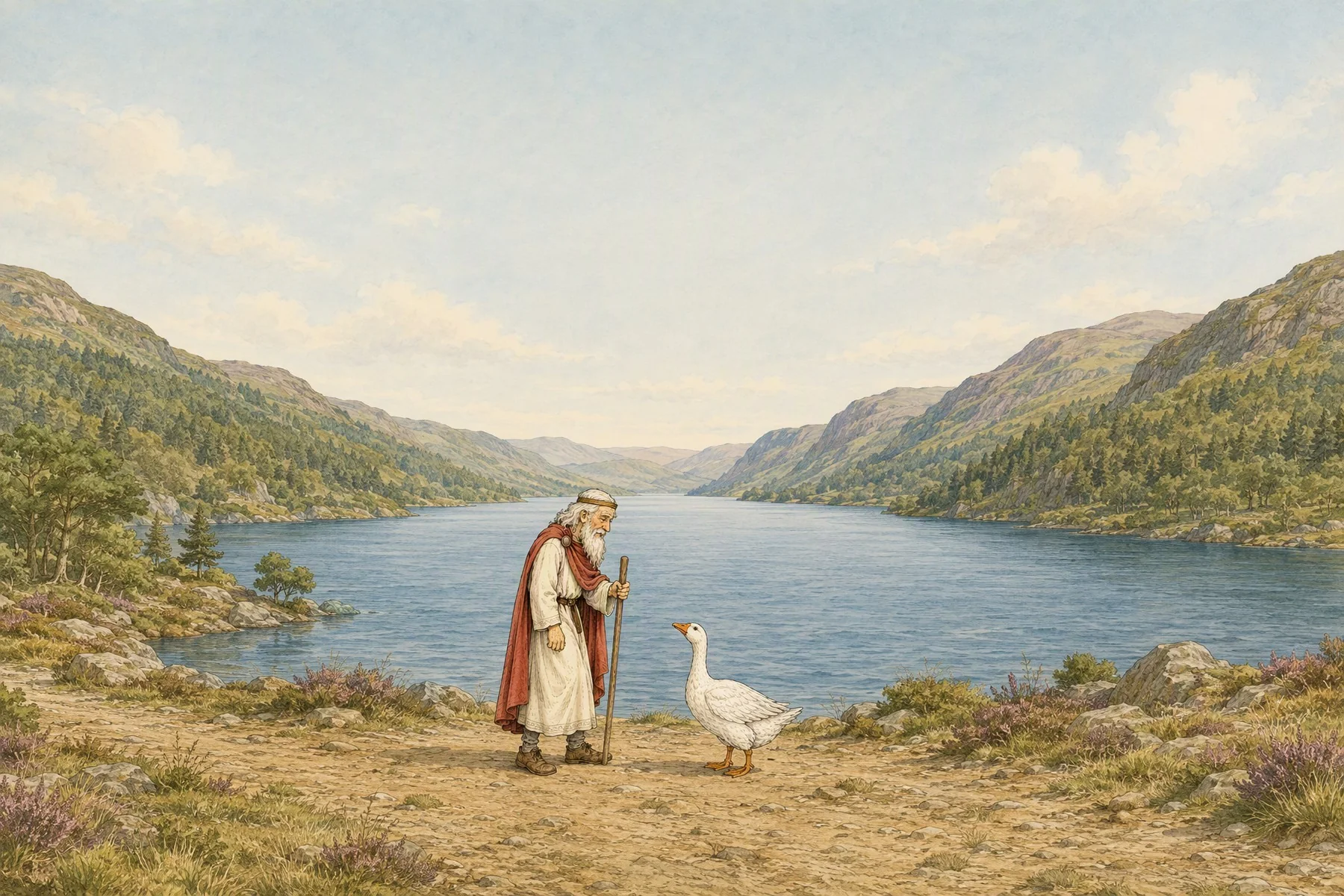
The old king

Long ago there was a king called King O’Toole, and he lived in Glendalough, the glen of the two lakes.
When he was young he loved hunting. At the rising of the sun, up he got, and away over the mountains after the deer.
But in time the king grew old, and stiff in his legs, and he could hunt no more.
“What will I do with myself all the long day?” said the poor king.
The goose

So the king got a goose to keep him company. Oh, you may laugh, but it is the truth I am telling you.
Every day the goose flew round and round the lake to cheer him.
She dived for trout, and every Friday she caught a fish for the king’s supper.
But in time the goose grew old like her master, and she could fly no more.
And then the poor king had nothing at all to cheer him.
The young man

One morning the king was walking by the lake, as sad as could be, when who should come round the corner but a young man.
“God save you,” said the king. “God and Mary save you, King O’Toole,” said the young man.
“How do you know my name?” said the king. “Oh, never mind,” said the young man. “And how is your goose?”
“How do you know about my goose?” said the king. “Never mind that either,” said the young man.
“And what trade have you?” said the king. “I make old things as good as new,” said the young man.
“What would you say if I made your old goose as good as new?”
The bargain

The king whistled, and up came the poor old goose, waddling like her master.
“I will do it,” said the young man. “But what will you give me?” “Whatever you ask,” said the king.
“Then give me all the ground the goose flies over, the first time she flies.”
“I will,” said the king. “You will not go back on your word?” “Honour bright!” said King O’Toole.
Then the young man took the goose by her two wings, and blessed her, and threw her up into the air.
“Whew!” said he, and gave her a puff to help her on her way.
The goose flies

And away she flew like an eagle, cutting as many capers as a swallow before the rain.
She flew over the two lakes and over the mountains, and round the whole glen.
And the king stood with his mouth open, watching his old goose flying as light as a lark.
The king’s word

She landed at his feet, and he patted her on the head. “My darling,” said he, “you are the darling of the world!”
“And will you give me all the ground the goose flew over?” said the young man.
“I will,” said King O’Toole, “and you are welcome to it, though it is the last acre I have.”
“You will keep your word?” “As true as the sun,” said the king.
“It is well for you that you said so,” said the young man. “If you had not, your goose would never have flown again.”
Who he was

“You are a decent man, King O’Toole. I only came here to try you.”
“Then who are you?” said the king. “I am Saint Kevin,” said the young man.
Down went the king on his knees. “And I thought I was only talking to a decent boy!” said he.
“Well, you know the difference now,” said the saint.
Glendalough

So the king had his goose as good as new, to cheer him for as long as he lived, and Saint Kevin looked after him all his days.
And that is how Saint Kevin came by the glen of the two lakes, where the round tower stands to this day.
For grown-ups
Where it comes from
Samuel Lover told this story of Glendalough in his Legends and Stories of Ireland. Joseph Jacobs printed it again in 1892, in Celtic Fairy Tales, and that is the telling we worked from.
What we changed
- It is less than half the length of the old telling.
- The old telling is written in a storyteller’s broad speech, spelt as it sounded. Ours is in plain words.
- In the old telling the king is so low that he thinks of drowning himself. Here he is only sad.
- In the old telling the king asks the young man whether he is a tinker. Here he asks him his trade.
- The old telling ends with the goose killed by an eel. Ours leaves that out.
- The last line, about the round tower, is ours. The old telling says only that the king “owned the churches in the early days”.
Age
Five and up.
Words
- Glendalough is Gleann Dá Loch, the glen of the two lakes, in the Wicklow mountains. Saint Kevin, Caoimhín in Irish, made his home there, and the round tower of his monastery still stands.
- “Honour bright!” is an old way of saying “on my honour”.
- “God save you” and “God and Mary save you” are the old greeting and its answer: Dia duit, and Dia is Muire duit.
- “My darling” is “Ma vourneen” in the old telling, which is the Irish a mhuirnín.
The tale as Joseph Jacobs printed it in 1892, after Samuel Lover
Och, I thought all the world, far and near, had heerd o' King O'Toole—well, well, but the darkness of mankind is untellible! Well, sir, you must know, as you didn't hear it afore, that there was a king, called King O'Toole, who was a fine old king in the old ancient times, long ago; and it was he that owned the churches in the early days. The king, you see, was the right sort; he was the real boy, and loved sport as he loved his life, and hunting in particular; and from the rising o' the sun, up he got, and away he went over the mountains after the deer; and fine times they were.
Well, it was all mighty good, as long as the king had his health; but, you see, in course of time the king grew old, by raison he was stiff in his limbs, and when he got stricken in years, his heart failed him, and he was lost entirely for want o' diversion, because he couldn't go a-hunting no longer; and, by dad, the poor king was obliged at last to get a goose to divert him. Oh, you may laugh, if you like, but it's truth I'm telling you; and the way the goose diverted him was this-a-way: You see, the goose used to swim across the lake, and go diving for trout, and catch fish on a Friday for the king, and flew every other day round about the lake, diverting the poor king. All went on mighty well until, by dad, the goose got stricken in years like her master, and couldn't divert him no longer, and then it was that the poor king was lost entirely. The king was walkin' one mornin' by the edge of the lake, lamentin' his cruel fate, and thinking of drowning himself, that could get no diversion in life, when all of a sudden, turning round the corner, who should he meet but a mighty decent young man coming up to him.
"God save you," says the king to the young man.
"God save you kindly, King O'Toole," says the young man.
"True for you," says the king. "I am King O'Toole," says he, "prince and plennypennytinchery of these parts," says he; "but how came ye to know that?" says he.
"Oh, never mind," says St. Kavin.
You see it was Saint Kavin, sure enough—the saint himself in disguise, and nobody else. "Oh, never mind," says he, "I know more than that. May I make bold to ask how is your goose, King O'Toole?" says he.
"Blur-an-agers, how came ye to know about my goose?" says the king.
"Oh, no matter; I was given to understand it," says Saint Kavin.
After some more talk the king says, "What are you?"
"I'm an honest man," says Saint Kavin.
"Well, honest man," says the king, "and how is it you make your money so aisy?"
"By makin' old things as good as new," says Saint Kavin.
"Is it a tinker you are?" says the king.
"No," says the saint; "I'm no tinker by trade, King O'Toole; I've a better trade than a tinker," says he—"what would you say," says he, "if I made your old goose as good as new?"
My dear, at the word of making his goose as good as new, you'd think the poor old king's eyes were ready to jump out of his head. With that the king whistled, and down came the poor goose, just like a hound, waddling up to the poor cripple, her master, and as like him as two peas. The minute the saint clapt his eyes on the goose, "I'll do the job for you," says he, "King O'Toole."
"By Jaminee!" says King O'Toole, "if you do, I'll say you're the cleverest fellow in the seven parishes."
"Oh, by dad," says St. Kavin, "you must say more nor that—my horn's not so soft all out," says he, "as to repair your old goose for nothing; what'll you gi' me if I do the job for you?—that's the chat," says St. Kavin.
"I'll give you whatever you ask," says the king; "isn't that fair?"
"Divil a fairer," says the saint; "that's the way to do business. Now," says he, "this is the bargain I'll make with you, King O'Toole: will you gi' me all the ground the goose flies over, the first offer, after I make her as good as new?"
"I will," says the king.
"You won't go back o' your word?" says St. Kavin.
"Honour bright!" says King O'Toole, holding out his fist.
"Honour bright!" says St. Kavin, back agin, "it's a bargain. Come here!" says he to the poor old goose—"come here, you unfortunate ould cripple, and it's I that'll make you the sporting bird." With that, my dear, he took up the goose by the two wings—"Criss o' my cross an you," says he, markin' her to grace with the blessed sign at the same minute—and throwing her up in the air, "whew," says he, jist givin' her a blast to help her; and with that, my jewel, she took to her heels, flyin' like one o' the eagles themselves, and cutting as many capers as a swallow before a shower of rain.
Well, my dear, it was a beautiful sight to see the king standing with his mouth open, looking at his poor old goose flying as light as a lark, and better than ever she was: and when she lit at his feet, patted her on the head, and "Ma vourneen," says he, "but you are the darlint o' the world."
"And what do you say to me," says 'Saint Kavin, "for making her the like?"
"By Jabers," says the king, "I say nothing beats the art o' man, barring the bees."
"And do you say no more nor that?" says Saint Kavin.
"And that I'm beholden to you," says the king.
"But will you gi'e me all the ground the goose flew over?" says Saint Kavin.
"I will," says King O'Toole, "and you're welcome to it," says he, "though it's the last acre I have to give."
"But you'll keep your word true?" says the saint.
"As true as the sun," says the king.
"It's well for you, King O'Toole, that you said that word," says he; "for if you didn't say that word, the devil the bit o' your goose would ever fly agin."
When the king was as good as his word, Saint Kavin was pleased with him, and then it was that he made himself known to the king. "And," says he, "King O'Toole, you're a decent man, for I only came here to try you. You don't know me," says he, "because I'm disguised."
"Musha! then," says the king, "who are you?"
"I'm Saint Kavin," said the saint, blessing himself.
"Oh, queen of heaven!" says the king, making the sign of the cross between his eyes, and falling down on his knees before the saint; "is it the great Saint Kavin," says he, "that I've been discoursing all this time without knowing it," says he, "all as one as if he was a lump of a gossoon?—and so you're a saint?" says the king.
"I am," says Saint Kavin.
"By Jabers, I thought I was only talking to a dacent boy," says the king.
"Well, you know the difference now," says the saint. "I'm Saint Kavin," says he, "the greatest of all the saints."
And so the king had his goose as good as new, to divert him as long as he lived: and the saint supported him after he came into his property, as I told you, until the day of his death—and that was soon after; for the poor goose thought he was catching a trout one Friday; but, my jewel, it was a mistake he made—and instead of a trout, it was a thieving horse-eel; and instead of the goose killing a trout for the king's supper—by dad, the eel killed the king's goose—and small blame to him; but he didn't ate her, because he darn't ate what Saint Kavin had laid his blessed hands on.