The Piper and the Púca
The one tune

Long ago, in Dunmore in the County Galway, there lived a piper who loved music more than anything in the world.
But no matter how hard he tried, he could only ever learn one tune, and that tune was called “The Black Rogue”.
One night he was coming home late from a dance, and he came to the little bridge beside his mother’s house.
He squeezed the bag of his pipes and began to play “The Black Rogue”, the only tune he had.
The púca

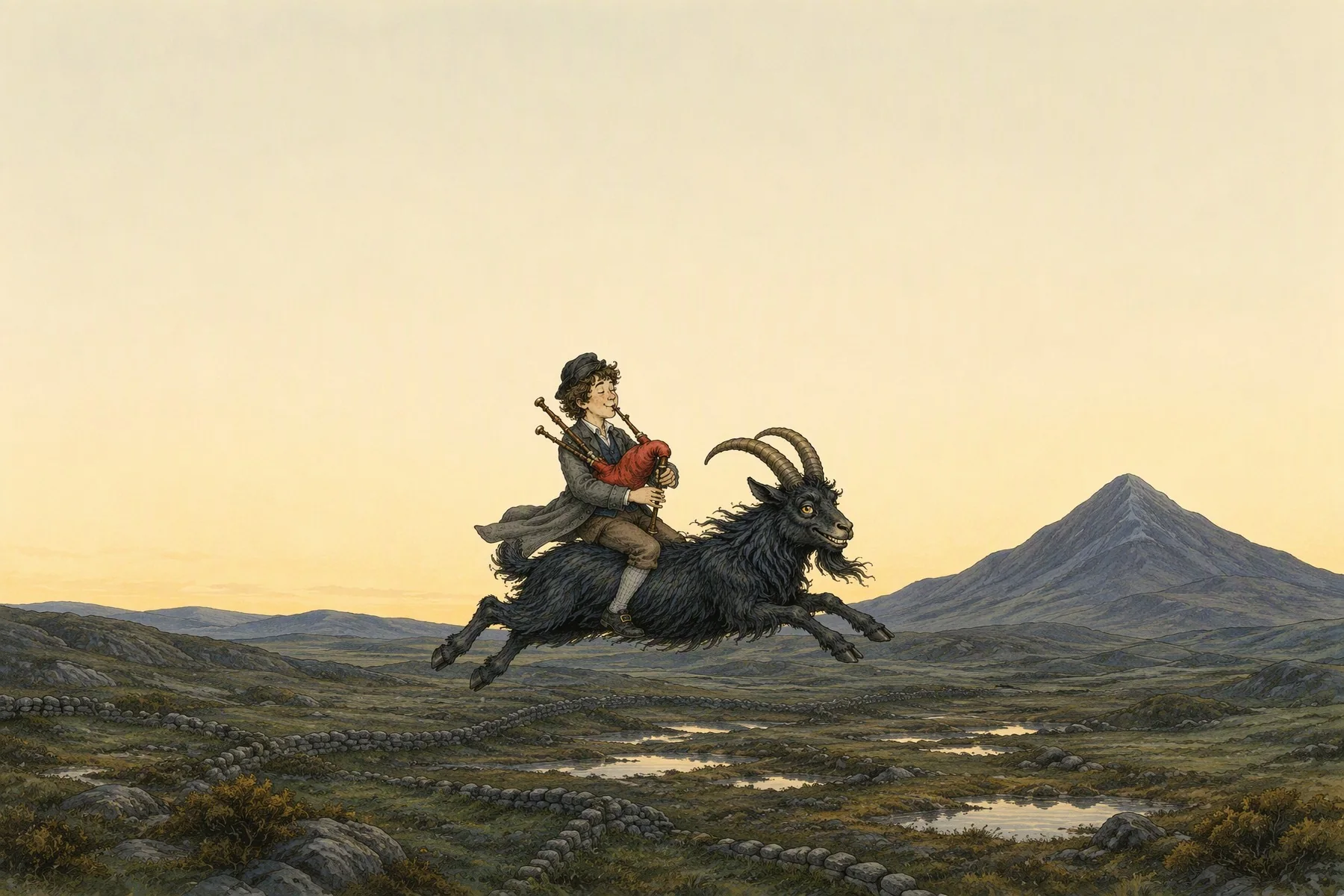
Then something came up behind him in the dark. It was the púca, and before the piper knew what was happening, the púca had thrown him up onto his back.
The púca had two long horns, and the piper took a good grip of them. “Let me go home, you wild beast!” he cried. “I have a ten-penny piece in my pocket for my mother.”
“Never mind your mother,” said the púca. “Hold on tight. If you fall off, that will be the end of you and your pipes!”
“Now play me ‘The Poor Old Woman’,” said the púca. “I don’t know that tune,” said the piper. “Never mind whether you know it or not,” said the púca. “Play, and I’ll make you know it.”
The piper blew up his bag and began to play, and such music came out of the pipes that he wondered at it himself.
Over hill and bog

“Upon my word, you’re a fine music-master,” said the piper. “But tell me, where are you taking me?”
“There is a great feast tonight in the house of the fairy women, on the top of Croagh Patrick,” said the púca.
“I’m bringing you there to play for them, and you’ll be well paid for your trouble.”
“Well, you’ll save me a journey, so,” said the piper. “Father William told me to climb Croagh Patrick to say I was sorry, because I took his white gander at Martinmas.”
Away went the púca with the piper on his back, over hills and bogs and rough places, until they came to the top of Croagh Patrick.
The house in the mountain

The púca struck the ground three times with his hoof, and a great door opened in the mountain. In they went together, into a fine big room.
In the middle of the room stood a golden table, and round it were hundreds of old women.
The old women rose up and said, “A hundred thousand welcomes to you, Púca of November! Who is this you have with you?”
“The best piper in Ireland,” said the púca.
The white gander

One of the old women struck the floor with her stick, and a door opened in the side of the wall.
And what should come out of it but the white gander, the very one the piper had taken from Father William!
“Well, upon my word,” said the piper. “My mother and I ate every bit of that gander, all but one wing!”
The gander cleared the golden table and carried everything away.
“Now,” said the púca, “play up some music for these ladies.”
The dance

The piper played, and the old women danced, and they danced and danced until they could dance no more.
Then the púca said that the piper must be paid, and every old woman took out a piece of gold and gave it to him.
“Look at me now,” said the piper. “I’m as rich as a lord’s son!”
Sense and music

“Come with me,” said the púca, “and I’ll bring you home.”
Just as the piper was getting up on the púca’s back, the white gander came to him and gave him a new set of pipes.
It was no time at all until the púca had him back in Dunmore, and he threw the piper off at the little bridge.
“Go home now,” said the púca. “You have two things tonight that you never had before: sense and music.”
The new pipes

The piper knocked at his mother’s door. “Let me in, mother! I’m as rich as a lord, and I’m the best piper in Ireland!”
“You’re dreaming,” said his mother. But she let him in, and he gave her all the gold. “Wait now,” said he, “till you hear the music I’ll play.”
He put on the new pipes and began to play. But instead of music, out came a noise as if all the geese and ganders in Ireland were screeching together!
The noise woke the neighbours, and they all came out and laughed at him, until he put on his old pipes. Then he played them music so sweet that it would charm the birds out of the bushes.
And he told them all that had happened to him that night.
The priest

Next morning, when his mother went to look at the gold, there was nothing there but a handful of withered leaves.
The piper went to Father William and told him the whole story.
But the priest would not believe a word of it, until the piper put on the new pipes, and out came the screeching of the geese and the ganders.
“Out of my sight, you rogue!” said the priest.
But the piper would not go until he had put on his old pipes, to show the priest that his story was true. And he played the sweetest music the priest had ever heard.
And from that day on, there was never a piper in all the County Galway as good as he was.
For grown-ups
Where it comes from
Douglas Hyde took this story down in Irish from the storytellers of Connacht, and put it word for word into English. W. B. Yeats printed his English in 1888, in Fairy and Folk Tales of the Irish Peasantry, and that is the telling we worked from.
What we changed
- In the old telling the piper is called a half fool, and he is half drunk on his way home from the dance. Here he is simply a piper who could only ever learn one tune.
- In the old telling his mother says “You’re drunk”. Here she says “You’re dreaming”.
- The old telling holds the feast in the house of the Banshee. The words mean a woman of the fairy hills, bean sí, and so we call the old women the fairy women.
- To keep it short we left out the snuff that the piper’s ten-penny piece was for, and Red Mary, who told the priest about the gander.
- In the old telling the priest calls the piper a thief, and the last line says that he was the best piper in Galway till the day of his death. Ours says rogue, and from that day on.
Age
Five and up.
Words
- The púca is a wild creature of the old stories who can take many shapes: a horse, an ass, a goat, an eagle. He is out and about most of all at Samhain, the beginning of November.
- The Black Rogue, An Rógaire Dubh, is an old tune. The Poor Old Woman, An tSeanbhean Bhocht, is another, often written the Shan Van Vocht.
- Croagh Patrick, Cruach Phádraig, is the holy mountain of County Mayo. People climb it to pray, and long ago some climbed it to show that they were sorry for what they had done.
- Dunmore, Dún Mór, is a small town in the north of County Galway.
- Martinmas is Saint Martin’s Day, the eleventh of November, when a goose was often roasted for the dinner. A gander is a father goose.
- Sense and music, ciall agus ceol, are the púca’s own words in Hyde’s Irish. A hundred thousand welcomes is céad míle fáilte.
The tale as W. B. Yeats printed it in 1888, in Douglas Hyde’s English
In the old times, there was a half fool living in Dunmore, in the county Galway, and although he was excessively fond of music, he was unable to learn more than one tune, and that was the "Black Rogue." He used to get a good deal of money from the gentlemen, for they used to get sport out of him. One night the piper was coming home from a house where there had been a dance, and he half drunk. When he came to a little bridge that was up by his mother's house, he squeezed the pipes on, and began playing the "Black Rogue" (an rogaire dubh). The Puca came behind him, and flung him up on his own back. There were long horns on the Puca, and the piper got a good grip of them, and then he said——
"Destruction on you, you nasty beast, let me home. I have a ten-penny piece in my pocket for my mother, and she wants snuff."
"Never mind your mother," said the Puca, "but keep your hold. If you fall, you will break your neck and your pipes." Then the Puca said to him, "Play up for me the 'Shan Van Vocht' (an t-seann-bhean bhocht)."
"I don't know it," said the piper.
"Never mind whether you do or you don't," said the Puca. "Play up, and I'll make you know."
The piper put wind in his bag, and he played such music as made himself wonder.
"Upon my word, you're a fine music-master," says the piper then; "but tell me where you're for bringing me."
"There's a great feast in the house of the Banshee, on the top of Croagh Patric to-night," says the Puca, "and I'm for bringing you there to play music, and, take my word, you'll get the price of your trouble."
"By my word, you'll save me a journey, then," says the piper, "for Father William put a journey to Croagh Patric on me, because I stole the white gander from him last Martinmas."
The Puca rushed him across hills and bogs and rough places, till he brought him to the top of Croagh Patric. Then the Puca struck three blows with his foot, and a great door opened, and they passed in together, into a fine room.
The piper saw a golden table in the middle of the room, and hundreds of old women (cailleacha) sitting round about it. The old women rose up, and said, "A hundred thousand welcomes to you, you Puca of November (na Samhna). Who is this you have with you?"
"The best piper in Ireland," says the Puca.
One of the old women struck a blow on the ground, and a door opened in the side of the wall, and what should the piper see coming out but the white gander which he had stolen from Father William.
"By my conscience, then," says the piper, "myself and my mother ate every taste of that gander, only one wing, and I gave that to Moy-rua (Red Mary), and it's she told the priest I stole his gander."
The gander cleaned the table, and carried it away, and the Puca said, "Play up music for these ladies."
The piper played up, and the old women began dancing, and they were dancing till they were tired. Then the Puca said to pay the piper, and every old woman drew out a gold piece, and gave it to him.
"By the tooth of Patric," said he, "I'm as rich as the son of a lord."
"Come with me," says the Puca, "and I'll bring you home."
They went out then, and just as he was going to ride on the Puca, the gander came up to him, and gave him a new set of pipes. The Puca was not long until he brought him to Dunmore, and he threw the piper off at the little bridge, and then he told him to go home, and says to him, "You have two things now that you never had before—you have sense and music (ciall agus ceol)."
The piper went home, and he knocked at his mother's door, saying, "Let me in, I'm as rich as a lord, and I'm the best piper in Ireland."
"You're drunk," said the mother.
"No, indeed," says the piper, "I haven't drunk a drop."
The mother let him in, and he gave her the gold pieces, and, "Wait now," says he, "till you hear the music I'll play."
He buckled on the pipes, but instead of music, there came a sound as if all the geese and ganders in Ireland were screeching together. He wakened the neighbours, and they were all mocking him, until he put on the old pipes, and then he played melodious music for them; and after that he told them all he had gone through that night.
The next morning, when his mother went to look at the gold pieces, there was nothing there but the leaves of a plant.
The piper went to the priest, and told him his story, but the priest would not believe a word from him, until he put the pipes on him, and then the screeching of the ganders and geese began.
"Leave my sight, you thief," says the priest.
But nothing would do the piper till he would put the old pipes on him to show the priest that his story was true.
He buckled on the old pipes, and he played melodious music, and from that day till the day of his death, there was never a piper in the county Galway was as good as he was.