The Salmon of Knowledge
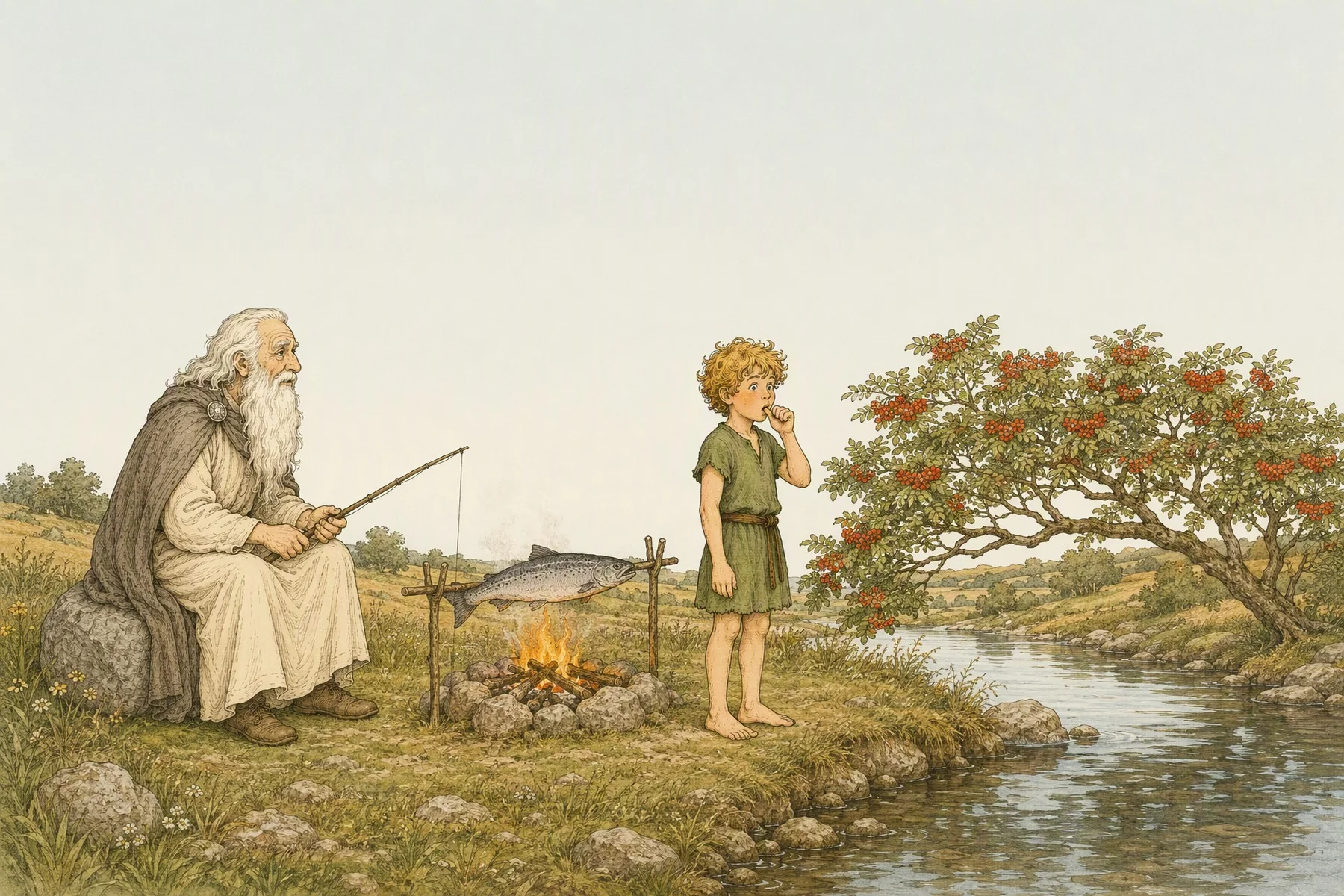
The boy in the woods

Long ago, before he was the great Fionn mac Cumhaill, Fionn was a boy, and his name was Deimne.
His father had many enemies, and so the boy was brought up in secret, deep in the woods of Slieve Bloom, by two wise women.
They taught him to run as fast as the deer and to swim like a fish, and he grew up quick and strong, with hair as fair as the sun.
When he was old enough, it was time for him to learn the greatest thing of all, and that was poetry.
For in those days a poet knew all the old stories, the names of every hill and river, and the secrets of the world.
So off he went to the River Boyne, to learn from a poet called Finnéces.
The old poet

Finnéces lived beside a deep, still pool on the Boyne, and for seven long years he had been watching that pool.
For in the pool there lived a salmon. It had been foretold that Finnéces would eat that salmon, and that after he had eaten it, there would be nothing in the world that he did not know.
“Seven winters and seven summers I have waited for it,” said the old poet. And still he watched the pool, day after day.
The salmon

Then one day, at long last, the salmon was caught. It was a great silver fish, shining in the sun: the salmon of knowledge.
“Deimne,” said Finnéces, “cook this salmon for me. But mind you, do not eat one bit of it, not even the smallest taste.”
“I will not,” said the boy.
The blister

Deimne made a fire on the bank, and he set the salmon over it on a spit, and he turned it round and round with great care.
As it cooked, a blister rose up on the salmon’s skin. The boy pressed it down with his thumb, so that the salmon would be perfect for his master.
But the skin was hot, and it burned his thumb! Quick as a wink, he put his thumb in his mouth to cool it.
Fionn

Then Deimne brought the cooked salmon to the poet.
“Have you eaten any of the salmon, my lad?” said Finnéces.
“No,” said the boy. “But I burned my thumb on it, and I put my thumb in my mouth.”
The old poet looked at him for a long while. “What is your name, my lad?” said he. “Deimne,” said the boy.
“Fionn is your name, my lad,” said Finnéces. “Fionn, the fair one. It was to you that the salmon was given to be eaten, and you are the Fionn.”
And so the boy ate the salmon of knowledge.
The thumb of knowledge

From that day on, whenever Fionn wanted to know a thing, he had only to put his thumb in his mouth, and then he knew it.
He grew up to be Fionn mac Cumhaill, the wisest and the bravest of all the Fianna of Ireland.
And many years after, when a great giant was on his way to fight him, it was his thumb that told him so. But that is another story.
For grown-ups
Where it comes from
This is one of the oldest stories of Fionn. It comes from an Irish tale of about the twelfth century, Macgnímartha Finn, The Boyhood Deeds of Fionn, which survives in a single manuscript of the fifteenth century. Kuno Meyer put it into English in 1904, and his English is what we worked from. The blister on the salmon’s skin is from Lady Gregory’s telling in Gods and Fighting Men, of the same year.
What we changed
- The old tale tells much more of Fionn’s boyhood, and of how his father died. We begin with him already in the woods.
- In the old tale the knowledge comes when Fionn puts his thumb in his mouth and chants a poet’s chant. Here, as in the fireside tales, the thumb is enough.
- In the oldest telling the boy simply burns his thumb on the salmon. The blister is Lady Gregory’s.
- The last line is ours: it points to another of our tales, Fionn and the Giant in the Cradle.
Age
Five and up.
Words
- Fionn means fair, or bright. Deimne was his name as a boy.
- Finnéces, Finnéigeas in Irish, is often written Finegas or Finnegas in English.
- The salmon of knowledge is an bradán feasa: feasa means of knowledge.
- The Boyne, An Bhóinn, is the river that flows past Newgrange to the sea at Drogheda. Slieve Bloom, Sliabh Bladhma, is a range of mountains in the middle of Ireland.
- The Fianna were the band of warriors and hunters that Fionn led.