The White Trout
The lady of the lake

Long ago, in a castle by the lake at Cong, there lived a beautiful lady.
She was promised to a king’s son, and they were to be married. But one day the king’s son went out on the lake, and he never came back.
The lady’s heart was broken. She grieved and grieved for him, until one day she was gone, and nobody ever saw her again. People said that the fairies had taken her away.
The white trout

Some time after that, a white trout was seen in the stream that runs out of the cave at Cong.
Nobody had ever heard of a white trout before, and the people did not know what to think of it.
Years and years went by, and there the white trout always was, in the very same place.
At last the people said that it must be a fairy. And nobody ever did it any harm.
The soldier

Then one day some soldiers came to Cong, and they laughed at the people for thinking that a trout could be a fairy.
One soldier laughed louder than all the rest. “I’ll catch that trout,” said he, “and I’ll eat it for my dinner!”
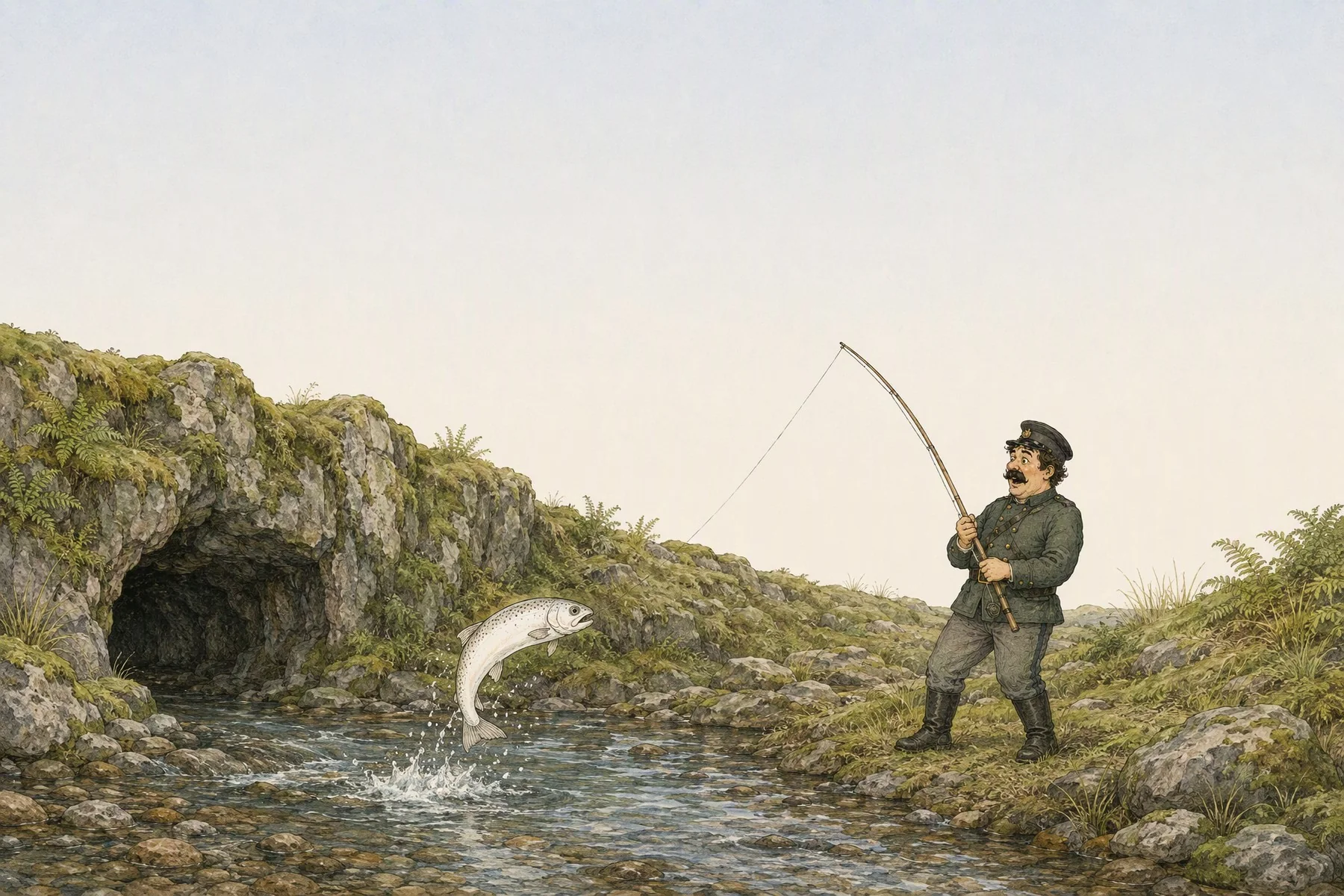
And sure enough, he caught it, and away home with him.
The frying pan

He put the frying pan on the fire, and into it he threw the pretty little trout.
The trout gave a cry like a little child. But the soldier only laughed.
When he thought one side was done, he turned it over to fry the other. But there was not a mark of the fire on it at all.
“Well, that beats the world,” said the soldier. “But I’ll try you again.” He turned it over and over, but there was never a sign of the fire on the pretty trout.
“Well,” said he, “maybe you’re fried enough, though you don’t look it.” And he took up his knife and fork to taste a piece.
The lady in white

The minute his knife touched the fish, there was a terrible scream, and out of the pan jumped the trout, into the middle of the floor.
And on the very spot where it fell, up rose a lovely lady, dressed in white, with a band of gold in her hair and a little red cut on her arm.
“Look where you cut me!” said she, and she held out her arm to him. “Could you not leave me cool and comfortable in the river where you found me, and not disturb me at my duty?”
The soldier shook like a dog in a wet sack. He begged her pardon, and he said that he never knew she was on duty.
On duty

“I was on duty,” said the lady. “I was watching for my true love, who is coming to me by water.”
“And if he comes while I am away, and I miss him, I’ll turn you into a pinkeen, and I’ll chase you up and down for evermore, while grass grows and water runs!”
The soldier begged her to have mercy on him.
“Then be a good man from this day on,” said the lady. “And now take me back, and put me into the river where you found me.”
“Oh, my lady,” said the soldier, “how could I have the heart to put a beautiful lady like you into the river?”
But before he could say another word, the lady was gone, and there on the floor lay the little white trout.
Back to the river

He put the trout on a clean plate, and away he ran as fast as his legs could carry him, for fear her true love would come while she was away.
He ran and he ran, until he came to the cave, and he put the trout back into the river.
And to this day there is a little red mark on the white trout’s side, where the knife touched her.
From that day on the soldier was a changed man. He never ate a fish again as long as he lived, and every day he said a prayer for the white trout.
And if you go to Cong and look into the stream by the cave, you may see the white trout there still, with the little red mark on her side, watching for her true love.
For grown-ups
Where it comes from
Samuel Lover told this story, a legend of Cong in County Mayo, as a guide might tell it to a visitor beside the stream. W. B. Yeats printed it again in 1888, in Fairy and Folk Tales of the Irish Peasantry, and that is the telling we worked from.
What we changed
- In the old telling the king’s son is murdered and thrown into the lake. Here he goes out on the lake and never comes back.
- In the old telling the lady goes out of her mind with grief. Here her heart is broken.
- In the old telling blood runs down the lady’s arm, and the river runs red for a while. Here there is only a little red cut.
- In the old telling the soldier leaves the army in the end and lives alone as a hermit, praying for the white trout. Ours says only that he said a prayer for her every day.
- The old telling is in the country speech of its day, spelt as it sounded. Ours is in plain words.
Age
Five and up.
Words
- Cong, Conga, is a village in County Mayo between Lough Corrib and Lough Mask. Under it the water of one lake runs through caves in the rock to the other.
- A pinkeen is a tiny little fish, a pincín.
- A trout, breac, is a fish of rivers and lakes, brown and speckled. A white one is a wonder.
The tale as W. B. Yeats printed it in 1888, after Samuel Lover
There was wanst upon a time, long ago, a beautiful lady that lived in a castle upon the lake beyant, and they say she was promised to a king's son, and they wor to be married, when all of a sudden he was murthered, the crathur (Lord help us), and threwn into the lake above, and so, of course, he couldn't keep his promise to the fair lady,—and more's the pity.
Well, the story goes that she went out iv her mind, bekase av loosin' the king's son—for she was tendher-hearted, God help her, like the rest iv us!—and pined away after him, until at last, no one about seen her, good or bad; and the story wint that the fairies took her away.
Well, sir, in coorse o' time, the White Throut, God bless it, was seen in the sthrame beyant, and sure the people didn't know what to think av the crathur, seein' as how a white throut was never heard av afor, nor since; and years upon years the throut was there, just where you seen it this blessed minit, longer nor I can tell—aye throth, and beyant the memory o' th' ouldest in the village.
At last the people began to think it must be a fairy; for what else could it be?—and no hurt nor harm was iver put an the white throut, until some wicked sinners of sojers kem to these parts, and laughed at all the people, and gibed and jeered them for thinkin' o' the likes; and one o' them in partic'lar (bad luck to him; God forgi' me for saying it!) swore he'd catch the throut and ate it for his dinner—the blackguard!
Well, what would you think o' the villainy of the sojer? Sure enough he cotch the throut, and away wid him home, and puts an the fryin'-pan, and into it he pitches the purty little thing. The throut squeeled all as one as a christian crathur, and, my dear, you'd think the sojer id split his sides laughin'—for he was a harden'd villain; and when he thought one side was done, he turns it over to fry the other; and, what would you think, but the divil a taste of a burn was an it at all at all; and sure the sojer thought it was a quare throut that could not be briled. "But," says he, "I'll give it another turn by-and-by," little thinkin' what was in store for him, the haythen.
Well, when he thought that side was done he turns it agin, and lo and behould you, the divil a taste more done that side was nor the other. "Bad luck to me," says the sojer, "but that bates the world," says he; "but I'll thry you agin, my darlint," says he, "as cunnin' as you think yourself;" and so with that he turns it over and over, but not a sign of the fire was on the purty throut. "Well," says the desperate villain—(for sure, sir, only he was a desperate villain entirely, he might know he was doing a wrong thing, seein' that all his endeavours was no good)—"Well," says he, "my jolly little throut, maybe you're fried enough, though you don't seem over well dress'd; but you may be better than you look, like a singed cat, and a tit-bit afther all," says he; and with that he ups with his knife and fork to taste a piece o' the throut; but, my jew'l, the minit he puts his knife into the fish, there was a murtherin' screech, that you'd think the life id lave you if you hurd it, and away jumps the throut out av the fryin'-pan into the middle o' the flure; and an the spot where it fell, up riz a lovely lady—the beautifullest crathur that eyes ever seen, dressed in white, and a band o' goold in her hair, and a sthrame o' blood runnin' down her arm.
"Look where you cut me, you villain," says she, and she held out her arm to him—and, my dear, he thought the sight id lave his eyes.
"Couldn't you lave me cool and comfortable in the river where you snared me, and not disturb me in my duty?" says she.
Well, he thrimbled like a dog in a wet sack, and at last he stammered out somethin', and begged for his life, and ax'd her ladyship's pardin, and said he didn't know she was on duty, or he was too good a sojer not to know betther nor to meddle wid her.
"I was on duty, then," says the lady; "I was watchin' for my true love that is comin' by wather to me," says she, "an' if he comes while I'm away, an' that I miss iv him, I'll turn you into a pinkeen, and I'll hunt you up and down for evermore, while grass grows or wather runs."
Well the sojer thought the life id lave him, at the thoughts iv his bein' turned into a pinkeen, and begged for mercy; and with that says the lady—
"Renounce your evil coorses," says she, "you villain, or you'll repint it too late; be a good man for the futhur, and go to your duty reg'lar, and now," says she, "take me back and put me into the river again, where you found me."
"Oh, my lady," says the sojer, "how could I have the heart to drownd a beautiful lady like you?"
But before he could say another word, the lady was vanished, and there he saw the little throut an the ground. Well he put it in a clean plate, and away he runs for the bare life, for fear her lover would come while she was away; and he run, and he run, even till he came to the cave agin, and threw the throut into the river. The minit he did, the wather was as red as blood for a little while, by rayson av the cut, I suppose, until the sthrame washed the stain away; and to this day there's a little red mark an the throut's side, where it was cut.
Well, sir, from that day out the sojer was an altered man, and reformed his ways, and went to his duty reg'lar, and fasted three times a-week—though it was never fish he tuk an fastin' days, for afther the fright he got, fish id never rest an his stomach—savin' your presence.
But anyhow, he was an altered man, as I said before, and in coorse o' time he left the army, and turned hermit at last; and they say he used to pray evermore for the soul of the White Throut.